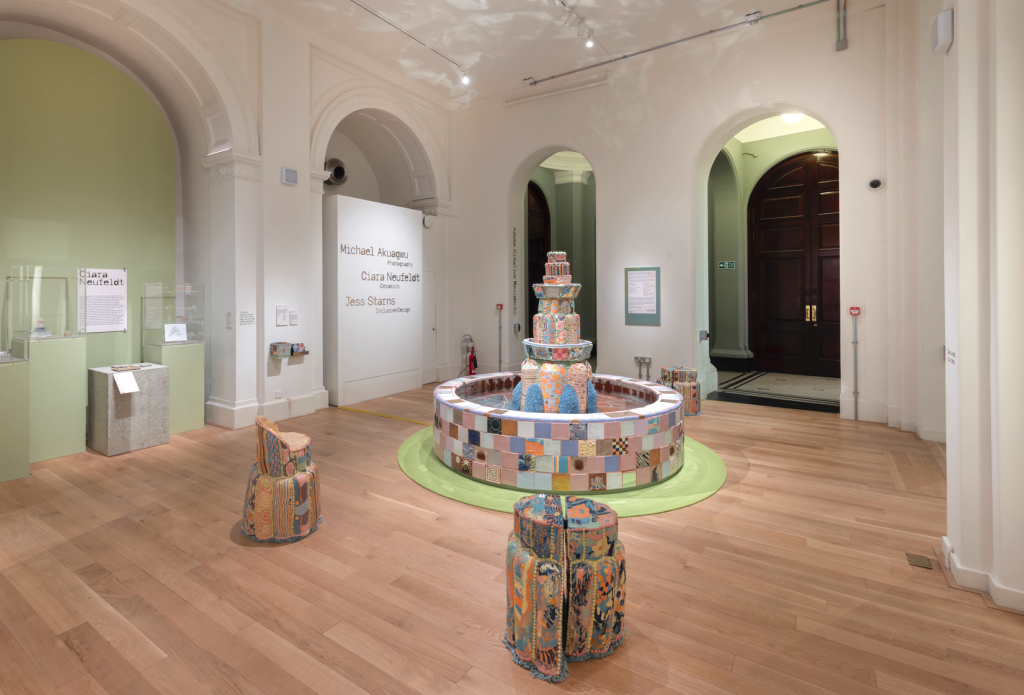
Ciara Neufeldt is an artist, craftsperson and facilitator whose practice moves between ceramics, textiles, installation and public engagement. Working across studio making and community-led projects, she creates colourful, tactile environments that bring moments of joy and care into everyday life.
Recently, Ciara visited the CAN Reuse Hub to collect clay for Digging Down, a collaborative project with InCahootz Creative Citizens exploring nature, recovery and community resilience. We caught up with her to talk about collaboration, circularity, Nerikomi, quilting, and how shared resources like CAN can support artists working across communities.
Your practice moves between ceramics, installation, public engagement and facilitation. How do collaboration and working with communities shape the way you approach making and the role you think art can play in everyday life?
Initially, I was interested in situating work in public space and daily life, as I believe the places we inhabit and the objects in them, directly affect how we feel. I wanted to reimagine what everyday objects such as a public bin or bench could look like, and transform them into colourful, participatory objects for anyone passing by to engage with.
But my practice has been growing in a direction which now brings that engagement with others into earlier moments of my artistic process, and questions how can we collectively make art for the environments within our everyday life together.
I feel that through collaboration we can create more access to art in everyday life, one example being through workshops with communities. The importance of these workshops lies equally in the actual act of making and being together, as well as within a final outcome.
Please Take a Seat and Please Throw Away Your Rubbish, 2023
Through collaborating with other artists and communities, it has changed my own approaches to making and how I think towards final work. My work has shifted towards installations that consist of different elements; I question how multitudes can be brought together, and through a collaborative practice the final object consists of different expressions, rather than just one. Collaboration can of course be many different things depending on who’s in the group and what we’re working on. For example, it might be community led – so the material and processes can shift entirely from what I might have expected, depending on what it is people want to do together. It’s fantastic to be led by others, and through that I personally learn so much more than if I were making alone in a studio. I hope to share art and craft in different ways, from workshops through to participatory experiences, and through that bring even just a moment of delight to someone’s everyday.
Make a Wish, 2025 Fountain and tiles made by Ciara Neufeldt and Fine Cell Work apprentices, with support from artists Charlie Brookes and Méabh Breathnach.
Quilted Jelly Stools, 2025 Made by Ciara Neufeldt and families during the Spring Family Festival.
Ceramics can often involve intensive material processes. Do ideas around reuse, circularity, or material stewardship factor into your practice, either practically or conceptually? Has that relationship changed over time?
From a ceramic standpoint, I started my journey by wheel-throwing and pottery production, where it was about producing and replicating multiples. But since moving into handbuilding and larger-scale, my relationship with making has become much slower, and for me personally, more intentional. Practically, there is circularity within my ceramic practice in how I re-use the scraps of patterns directly back into the piece itself; so those tiny flecks of pattern you can see actually come from the act of fettling the surface, and they are then returned to the surface itself.
A recent project ‘Digging Down’, was a collaboration with InCahootz Creative Citizens, Rachel Mimiec and Viv Lee – and it was also the reason I visited the CAN Reuse Hub! Again, through the joy of collaboration, I learnt so much about environmental stewardship in relation to artist practice. Viv shared her approach to foraging on a guided walk, teaching us her ethical and thoughtful methods of gathering materials from nature. So, I feel my relationship to circularity and material stewardship is always growing, through what I learn from others.
My making practice has also been evolving this year as I have been learning how to quilt, and within my textile work I make an intentional choice to only use second-hand material. I find so much satisfaction in resourcefulness, in working slowly and in being inefficient – rather than just being able to quickly buy or access everything I feel I want. Ultimately, I’m interested in care and appreciation for material, environment and each other.
Celestial Side Table, 2023 Close-up showing areas of texture made from the fettling scraps.
Your work often creates moments of joy, participation and accessibility. Are there particular materials, techniques or processes that you keep returning to, and what draws you to them?
I’m drawn to craft processes, through materials such as clay and textiles, as I feel they create experiences and environments that are mindful and joyful.
In ceramics, I predominantly work with the ‘Nerikomi’ technique, which consists of layering different colours of clay together to create patterns. Traditionally, this technique is about creating extremely precise outcomes, however, I take a looser approach and I’m interested in building up surface texture. I love ‘Nerikomi’ because ultimately, it’s just really fun and it brings me joy! It’s also a great technique when working with others, as it allows for a direct use of colour and pattern, which in the ceramic process, usually doesn’t exist until an object is fully glazed.
As mentioned, I’ve also recently started working with textiles, because as a material it echoes much of my interests in colour, texture and pattern. In particular, I’m drawn to quilting, for its ability to enable many hands to create together; it allows for individual expression which can then exist within a collaboratively made object. It’s also a lot cleaner than working with clay! Which can create more accessibility, as I can bring it into a wide variety of community spaces and meet people where they are, rather than folk having to travel to the ceramic studio.
So, I’m really enjoying learning new processes and I’m excited for how textiles might become a part of my practice as I move forwards.
Quilted Jelly, 2025 The colour and pattern come directly from stained coloured clay, using the Nerikomi technique, and the surface is finished with a transparent glaze.
You recently used CAN and collected clay from the Reuse Hub. What has your experience of CAN been like so far, and how useful do you think this kind of shared infrastructure is for artists and community-based practices?
It was fantastic! I think it’s an absolutely incredible resource and definitely one that I will be using again.
I feel the support that CAN offers is the beginning of a wonderful domino effect for artists who work with communities; these artists are then able share the material resources, thereby creating more access to art, thereby creating more positive experiences for people!
Specifically, I picked up a bag of beautiful black clay, which was then used in workshops at InCahootz, directly giving people access to a material we otherwise couldn’t have used.
Our project explored the connection between nature, recovery and community resilience, and I feel much of that resonates with CAN. Sustainable material use is so important, but also, people come together as a community on the website to offer car shares, upcoming workshops and to ask for things that are needed. It really feels that CAN has created a caring and supportive network for artists in many different ways.
Digging Down, 2026 A selection of work made by InCahootz artists for their exhibition ‘Digging Down’, using black clay collected from CAN.
As the Reuse Hub develops, is there anything you’d love to see more of — whether materials, facilities, ways of working, or forms of support? Are there any gaps or improvements that you think would make CAN even more useful for artists?
CAN is amazing and it’s already filling a gap of circularity and community building that responds to the needs of artists. The Reuse Hub also creates direct access to materials, which for many people can be a huge financial barrier to making art. So, I have no improvements to suggest. I actually just feel we are very lucky for the work being done by the CAN team, to create such wonderful and accessible resource – so a big thank you to you all!